The city was on the defensive line during the invasion of Napoleon Bonaparte's French troops in 1808. And Zaragoza remembers the epic siege. Here we find monuments and relics, such as the statue of the heroic Agustina of Aragon or the sword of Captain General José de Palafox in the city hall of Zaragoza.
From the centenary Puente de Piedra you can better appreciate the magnificence of the Cathedral Basilica, towers and domes, whose construction began in the 17th century and today is the largest Baroque church in Spain.
The immense interior space of the building, with vaults painted by Goya, holds the presence of La Pilarica, the small and highly venerated image of the Virgin of Pilar.
But if you choose to get to the Catholic temple along Paseo Alfonso I, you will be surprised to see the main dome emerging between two rows of well-maintained buildings.
At one end of the enormous Plaza del Pilar, packed with shops, bars and restaurants, stands out another cathedral, El Salvador (La Seo), whose subtle baroque façade denotes an unusual mix of styles on the side, from Romanesque and Gothic to Mudejar and Baroque.
If you’re captivated by the exterior walls of La Seo, wait, and see inside. You’ll be impressed by highly decorative motifs that arouse astonishment, where an important collection of Flemish tapestries stands.
In the center of Zaragoza, we also find the Aragonese Renaissance palace of the old market, built in the 16th century, with its star-crossed vaults. Also, the magnificent halls of the Arab palace of La Aljafería, 11th century, which survived the times, and today it’s attached to a modern and dissimilar building that houses the autonomous parliament of the Spanish region.
Museums
Goya Museum is only a few steps from Plaza del Pilar, where you can see some essential paintings and the four series of engravings by the Zaragoza painter.
In Plaza de San Felipe, Pablo Gargallo Museum stand out, located in a 17th century palace that houses more than 150 art pieces made by the Aragonese sculptor.
Yes, churches are museums because they house art in various forms, and that of Santa Isabel de Portugal is exceptional.
The façade of the temple brings baroque superiority, so characteristic of the constructions conducted at the end of the 17th century; worked in alabaster, white and dark colors, marble, and plaster.
Once inside the building, the ceiling made of gold details is eye-catching: the main dome and four other smaller ones, like the style used in the Cathedral Basilica.
The central altarpiece of the church, raised between 1750 and 1760, shows a polychrome structure made of jaspers stone, marble, and paint imitating gold.
Jose Marti
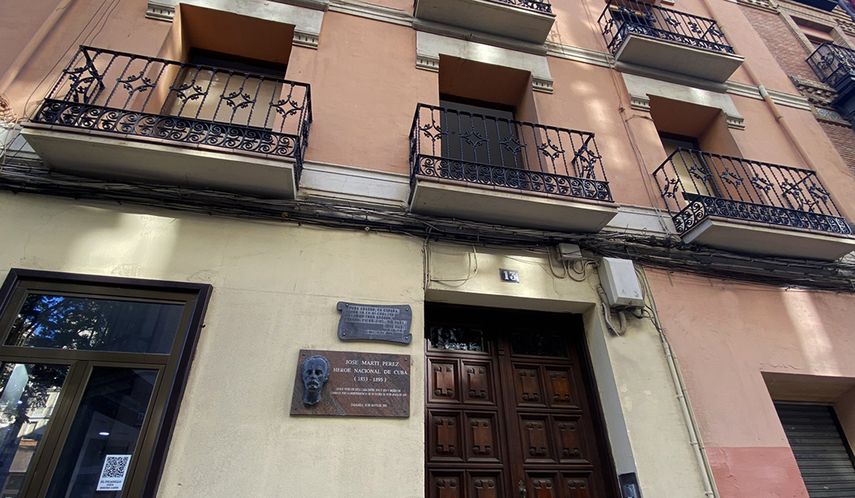
It was in Zaragoza where the Cuban born poet, thinker, and initiator of literary modernism in Latin America José Martí graduated with a degree in Civil Law, Philosophy and Letters.
A plaque on the wall on Calle Manifestación # 13 tells us the house where Martí used to live.
For brave Aragon, in Spain,
I have a place in my heart
Which of Aragon´s a part-
Frank, fierce, faithful, without stain.
If a fool can´t comprehend
Why this is so, I´ll explain:
That there I met a good friend,
And a woman's love did gain.
Eats
We must mention the Central Market of Zaragoza or Lanuza. It’s not just a place to shop; it's a cultural and gastronomic experience. Here you chat to vendors and learn about the daily activities of locals, as you become familiar with the products of the region, cheeses, and sausages, and enjoy tapas bars as well.
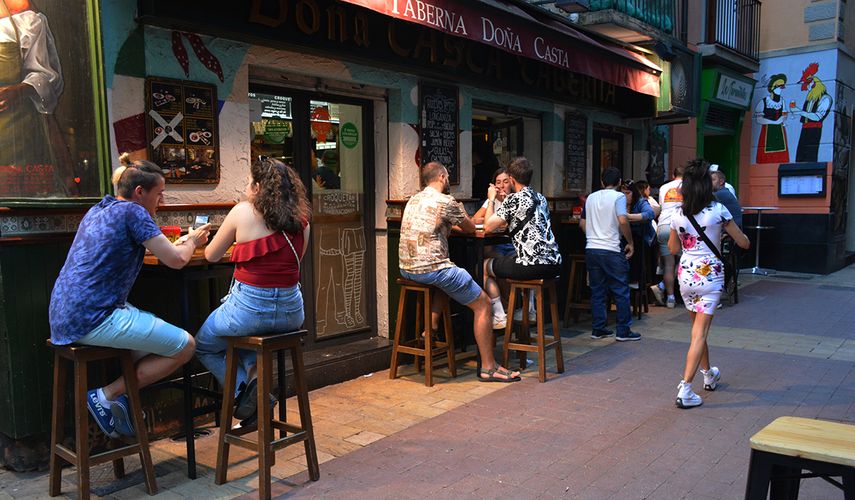
When it comes to tapas, El Tubo neighborhood, the gastronomic heart of Zaragoza, located next to Paseo Alfonso I, holds countless popular bars and restaurants.
The unique name, given by the narrowness of its streets, is repeated by everybody as a meeting point.
Try the mushroom skewers from El Champi, the croquettes from Méli del Tubo or the tapas and wine from Bodegas Almau, a veteran bar that was founded in 1870.
Among the greatest restaurants in Zaragoza, the Montal Restaurant has been there since 1919, with its pork cheeks stewed in red wine or black rice with octopus and a large wine cellar.
Additional mention deserves the restaurants El Real and La Flor de Lis, which offer unique versions of regional cuisine.
Modern Zaragoza
Besides the buildings that tell us about the past, the Zaragoza looks forward.
Let’s start at the José Antonio Labordeta park, where you find the Rincón de Goya complex, the first example of rationalist architecture in Spain, built in 1927, to commemorate the first centenary of the death of Francisco de Goya.
On the northern bank of the river, Expo 2008 left examples of modernity such as the Third Millennium Bridge, the Water Tower, the Aragón Pavilion, and the Fluvial Aquarium, in addition to the challenging building of the Pablo Serrano Museum.
If you want to walk over the river, without being bothered by traffic, Pasarela del Voluntariado is a modern curved pedestrian and cyclist bridge that joins both banks of the watercourse.
How to get there?
There are several airlines that provide service from Miami and other metropolitan areas in the United States to Madrid or Barcelona, where you can board the high-speed train to Zaragoza.
If you carry a US passport you do not need a visa, but if you travel with a document from another country, contact your local Spanish consular office to receive the right information.
Where to stay
Zaragoza has a wide range of hotels for all budgets, such as the four-star Hotel Alfonso, very well located, a few steps from Plaza del Pilar and the El Tubo tapas neighborhood.
If you are planning a visit to Zaragoza and want to make the most of your time, we recommend an itinerary of at least three days to explore as many sites as possible that this beautiful city has to offer.