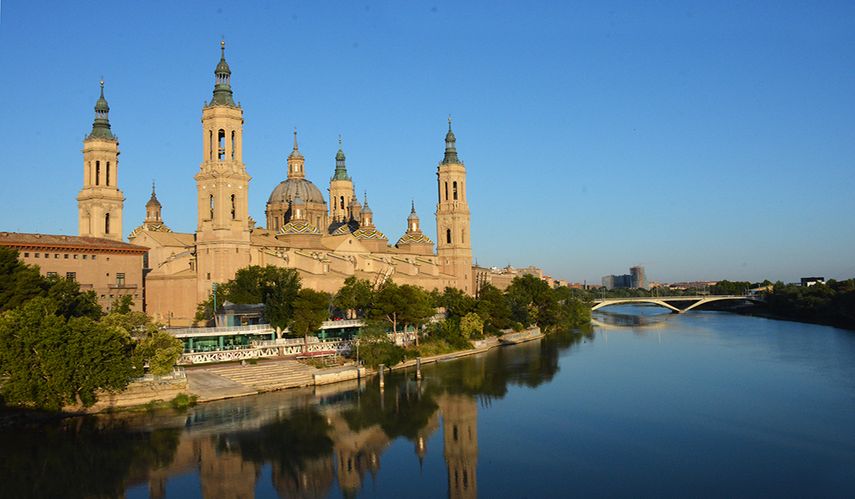
We start in Zaragoza, the capital city of Aragon, which is very well served by trains from Madrid and Barcelona. Here the cathedral basilica of Nuestra Señora del Pilar and the Ebro River get the attention first.
From the centenary Puente de Piedra you can better appreciate the magnificence of the Catholic sanctuary, with its towers and domes, built over 300 years ago. It’s the largest baroque temple in Spain.
But if you choose to walk along Paseo Alfonso I, you will be surprised to see the main dome of the cathedral basilica emerge between two blocks of well-kept buildings.
At one end of the enormous Plaza del Pilar, also packed with shops, bars and restaurants, the Cathedral of El Salvador (La Seo) stands out t. The baroque façade houses an impressive mix of styles, from Romanesque and Gothic to Mudejar and Baroque.
The historic center of Zaragoza has an overwhelming wealth of interesting places to visit. From the magnificent Arab palace of the Aljafería, that survived the test of time, to the many popular bars and tapas restaurants in El Tubo neighborhood.
This unique name, The Tube for English, is given by the narrowness of its streets and it is repeated by the people of Zaragoza as a popular meeting point.
It was in Zaragoza where the Cuban born poet, thinker, and initiator of literary modernism in Latin America José Martí graduated with a degree in Civil Law, Philosophy and Letters.
A plaque, located on Calle Manifestación # 13, announces the house where Martí used to live.
For brave Aragon, in Spain,
I have a place in my heart
Which of Aragon´s a part-
Frank, fierce, faithful, without stain.
If a fool can´t comprehend
Why this is so, I´ll explain:
That there I met a good friend,
And a woman's love did gain.
Huesca
On the way to the Pyrenees, surrounded by green and yellow fields, there are necessary stops to make. One is Huesca, whose foundations date back 6,000 years, as Visigoths, Romans and later Arabs inhabited the location, until the Christians conquered the area, and it became territory of the Kingdom of Aragon.
Nearby, where the high elevations take shape and the streams come to light, the Romanesque castle of Loarre overviews the entire wide plain from a large cliff. It was built in the 11th century and declared a National Monument in 1906.
Then we came across the town of Jaca, the starting point for skiing in the winter. Don’t miss the Cathedral of San Pedro de Jaca. This is one of the most characteristic and oldest Romanesque buildings in Spain. It was completed at the turn of the 12th. century
Near Jaca you can visit the Royal Monastery of San Juan de la Peña. This is a well-preserved Romanesque abbey, raised in the 11th century and nestled in an immense rock, where the remains of several kings of Aragon rest.
Pyrenees
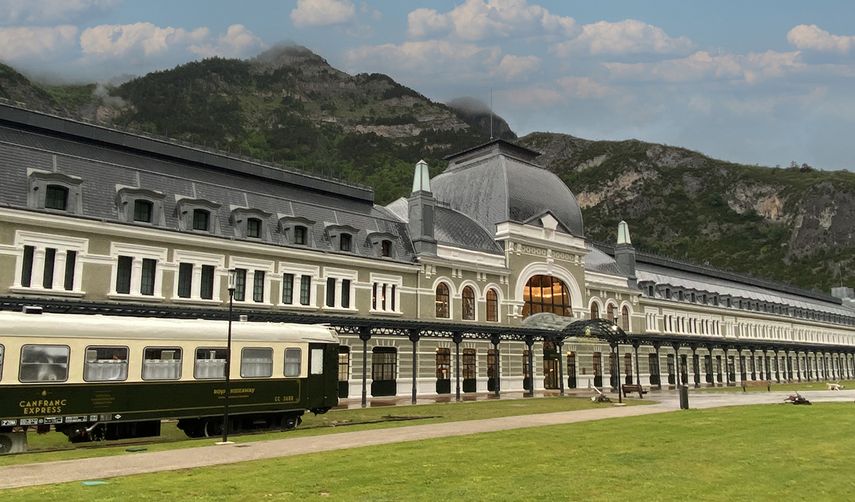
Arriving at the Pyrenees, remarkably close to the border with France, the Canfranc train station’s French palatial architecture is remarkable. It opened in 1928 and it serves the city of Huesca, as trains will run from Zaragoza soon.
Not too far from here you’ll find Ordesa and Monte Perdido National Park, where Mother Nature created another of its masterpieces at an altitude that rises to 11,000 feet (some 3,350 meters) above sea level.
Don't be afraid of the altitude. Drink enough water to hydrate the body and you will be ready to go forward.
Downhill we find an endless number of towns and villages that reveal the long journey of history since the Middle Age: Aínsa, Roda de Isábena, Graus and the very medieval Alquezar with picturesque old winding streets and paving stones and well-preserved historic buildings.
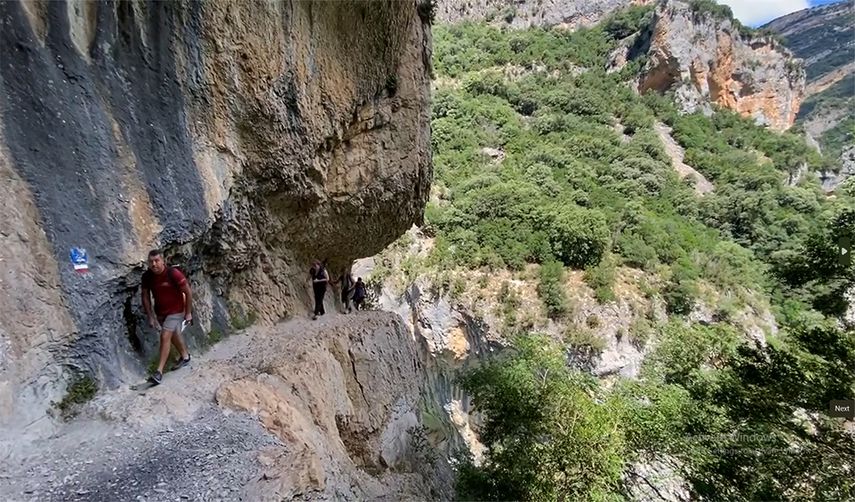
If you’re looking for hiking, walk the four miles of the Congosto del Entremón trail. The impressive canyon, carved by the Cinca River between high elevations, rocks, and curious caves, channels the flow of water from the El Grado reservoir.
South
Heading south, after crossing the great valley of the Ebro River, we arrive at Teruel. It is the city of the Islamic-Christian art Mudejar, of lovers and great local ham.
If tall colorful towers are impressive and beautiful, the polychrome tiles of the cathedral roof are magnificent.
About 30 minutes from Teruel is the very medieval town of Albarracín, which seems to hang from a mountain range that was refuge for people over 8,000 years ago. Walk the old winding streets and celebrate the red lime facades that make this town one of the most unique in Spain.
Gastronomy
As in all of Spain, gastronomy in Aragon is diverse and rich in meats, cheeses, and sausages.
If rabbits are one of the favorite meats, so is lamb, trout, chicken, pork, and the countless vegetables that enhance the flavor of typical dishes, such as migas with ham and grapes or roasted and shredded lamb.
How to get there?
There are several airlines that provide service from Miami and other metropolitan areas in the United States to Madrid or Barcelona, where you can board the train to Zaragoza, Huesca, or Teruel.
If you carry a US passport you do not need a visa, but if you travel with a document from another origin, contact the Spanish consular office to receive appropriate information.
Where to Stay
Aragón has a wide selection of accommodation for all budgets.
In Zaragoza we stayed at Hotel Alfonso, a four-star hotel that is very well located, a few steps from Plaza del Pilar and the El Tubo tapas neighborhood.
In the Pyrenees, the five-star Hotel Canfranc Estación, located inside the recently remodeled train terminal, gets the attention for tradition and modernity.
Another five-star, the Hotel Monasterio de Boltaña, near the Ordesa y Monte Perdido National Park, is nestled in a renovated 17th-century monastery, where original architecture and the comforts of the modern age coexist.
In Alquezar you have several options to stay overnight, and we highlight Hotel Villa de Alquezar and Hotel Castillo.
You can stay at El Mudayyan in Teruel, and take a tour to visit nearby Albarracín.